Complete Ram Chalisa lyrics in Hindi & English with verse-by-verse meaning. Authentic 40-verse Lord Rama prayer with pronunciation guide.
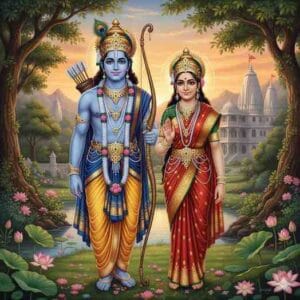
Ram Chalisa Lyrics: Complete 40 Verses Praising Lord Rama with Meaning
Are you searching for the complete Ram Chalisa lyrics in both Hindi and English with accurate translation? This comprehensive guide provides the authentic 40-verse prayer to Lord Rama that has been recited by millions of devotees for centuries.
The Ram Chalisa is a powerful devotional hymn consisting of exactly 40 verses (chalis means “forty” in Hindi) glorifying Lord Rama, the seventh avatar of Lord Vishnu. Unlike the more popular Hanuman Chalisa which praises Hanuman’s devotion, the Ram Chalisa directly celebrates Lord Rama’s divine qualities, righteous life, and supreme virtues. This sacred prayer takes only 10-15 minutes to recite but delivers profound spiritual benefits including protection, courage, family harmony, and alignment with dharma.
In this guide, you’ll find the complete Ram Chalisa in original Devanagari script, accurate English transliteration for proper pronunciation, detailed verse-by-verse meaning and translation, guidance on recitation and timing, and the key benefits of regular practice. Whether you’re in USA, UK, Canada, Australia, UAE, Singapore, or anywhere in the world, this authentic resource will help you connect deeply with Lord Rama’s grace.
Table of Contents
- Understanding Ram Chalisa – Brief Overview
- Complete Ram Chalisa in Hindi (Devanagari Script)
- Complete Ram Chalisa in English Transliteration
- Verse-by-Verse Translation and Meaning
- How to Recite Ram Chalisa
- Benefits of Regular Practice
- Frequently Asked Questions
- Conclusion
Understanding Ram Chalisa – Brief Overview
The Ram Chalisa belongs to the devotional Chalisa tradition of Hindi poetry, where exactly 40 verses (choupais) praise a particular deity. Composed during the Bhakti movement (16th-18th centuries CE), this prayer makes Rama worship accessible to everyone through simple Hindi rather than complex Sanskrit.
Key Features:
- Structure: Opening doha + 40 main verses + closing doha
- Language: Awadhi/Hindi dialect
- Duration: 10-15 minutes for complete recitation
- Focus: Lord Rama’s life, virtues, and divine qualities
- Purpose: Direct worship of Lord Rama for spiritual and worldly benefits
The Ram Chalisa narrates essential episodes from the Ramayana while glorifying Rama’s supreme qualities—righteousness, courage, devotion to duty, compassion, and perfect leadership. Regular recitation connects devotees with these divine attributes and brings Rama’s protective grace into daily life.
Complete Ram Chalisa in Hindi (Devanagari Script)
Here is the complete, authentic Ram Chalisa in original Devanagari script:
दोहा (Opening Doha)
श्री रामचन्द्र कृपालु भजु मन, हरण भव भय दारुणं।
नव कंज लोचन कंज मुख, कर कंज पद कंजारुणं॥
चालीसा (40 Verses)
1. बन्दउँ श्री राम चरन सुखदाई।
भव भय हरन धरन सुखदाई॥
2. सुमिरउँ सुर सरि गौरि गिरीसा।
सुमिरउँ पवन कुमार खगीसा॥
3. सुमिरउँ सारद सेष महेसा।
गुन गन नायक करउँ हुलेसा॥
4. सरनागत कलि काल विकराला।
भयउ प्रसन्न राम कृपाला॥
5. राम कृपा भव निधि सुख पावौं।
जो सुख होय सो कहि सुनावौं॥
6. राजीव नयन धरें धनु बाना।
भगत कृपाल अनुगृह राधिका राना॥
7. एहि भाँति गौर ईस हिम किरना।
सेवत लखन उर आनन्दना॥
8. बन्दउँ तुम पद कृपानिधाना।
सुर मुनि मन रंजन सुखपानां॥
9. दयाल दीन हित कृपा सिन्धु से।
वन्दे राम सकल गुन खान हो॥
10. जय राजीव लोचन राम, कमल मुख करुना धाम।
काह कहौं छबि आज की, भले बने हो राम॥
11. दयामय दीनानाथ, तुम करुणा के सागर।
हृदय कमल पर बिराजत, रघुकुल कमल दिवाकर॥
12. तुम सम नाथ न कोई, करुणा सिन्धु प्रभु सोई।
भरत सरीखो धरम जो धारे, सुग्रीव सरीस न दूजो॥
13. रघुकुल तिलक सुजस सुबानी।
कीर्ति जिमि लोक तीन महं मानी॥
14. त्रिलोक त्राता राम जग जनके।
भव सागर तारन को पावन गंगा॥
15. रघुपति कोसलनाथ महाराजा।
सुजस सुभग सब भूप सिरताजा॥
16. ब्रह्म महेस अज पूजहीं।
आदि देव मुनि ध्यावहीं॥
17. सुन्दर बदन कमल दल नयना।
तिलक त्रिपुण्ड राजत ललना॥
18. स्याम गौर सुन्दर दोउ भाई।
संग बिराजत अति सोभा पाई॥
19. तापस बेष बने बनवासी।
तीनों लोक में जसु बिलासी॥
20. जटा मुकुट मृगछाला सोहे।
सुमन सुमिरत अधिक सुख होये॥
21. धनुष बान कर सुन्दर साजा।
कटि निषंग तूनीर बिराजा॥
22. बरनौं पाव कमल अरुनाई।
जाके नख जोति सकल बिहाई॥
23. पायोजि सरोज समान राम।
लखन उर धरे बनान भये निधान॥
24. सुमिरत सुलोचन श्री रघुनाथ।
प्रगटे पयोधिनाथ तुम्हारे आगे॥
25. केवट कीन्ह प्रेम सनमाना।
लोक कल्याण हित अवतारा॥
26. संग लखन सिय रहनि बिहारी।
चित्रकूट में किये बिहारा॥
27. अगस्त्य मुनि आश्रम आये।
दण्डक बन सब सुभ बनाये॥
28. मुनि के श्राप ताड़का मारी।
सुबाहु खर दूषण संहारी॥
29. त्रिशिरा रावन मर्दन की।
सुरपति पाद पखारि पबन सुखदायी॥
30. रावन मारि सीय घर आये।
रुत बसन्त सम दरस दिखाये॥
31. सकल सुमंगल दायक राम।
विजय भए राम करि लीन्हा काम॥
32. भरत मिलन अति हर्ष उमाही।
राम रुप गुन जस बिलसाही॥
33. अयोध्या पुरी राज सिंहासन बैठे।
गरुड़ ध्वज फहरान सुख पावन लीन्हे॥
34. राम राज्य बहु सुख साज्या।
भये प्रजा सब सुख सम्पदा॥
35. राम नाम जो जपत निरन्तर।
होत न ता सम जग में दूसर॥
36. बिनु भजन जो मुक्ति न पावै।
सो नर यमपुर जाय दुख पावै॥
37. सूर समर कारन बढ़ आये।
बल बुद्धि बिद्या मन बसाये॥
38. छल कपट अरु पाप नसावहु।
राम भजन अनुपम फल पावहु॥
39. राम नाम को महिमा भारी।
टरत कोटि अपराध भारी॥
40. बेद पुरान बखानो जासो।
रामहि भजे बिनु मुक्ति न तासो॥
दोहा (Closing Doha)
काह कहौं श्री राम गुन, कहाँ लौं बरनौं नाम।
जाको यश त्रिभुवन बिदित, सोई मम इष्ट राम॥
Complete Ram Chalisa in English Transliteration
Here is the complete Ram Chalisa with accurate English transliteration:
DOHA (Opening Couplet)
Shri Ramachandra Kripalu Bhaju Man, Haran Bhava Bhaya Daarunam |
Nava Kanja Lochana Kanja Mukha, Kar Kanja Pada Kanjarunam ||
CHALISA (40 Verses)
1. Bandau Shri Rama Charana Sukhadaai |
Bhava Bhaya Harana Dharana Sukhadaai ||
2. Sumirau Sura Sari Gauri Gireesa |
Sumirau Pavana Kumara Khageesa ||
3. Sumirau Sarada Sesha Mahesha |
Guna Gana Nayaka Karau Hulesha ||
4. Saranagata Kali Kala Vikrala |
Bhayau Prasanna Rama Kripala ||
5. Rama Kripa Bhava Nidhi Sukha Pavau |
Jo Sukha Hoye So Kahi Sunavau ||
6. Rajeeva Nayana Dhare Dhanu Bana |
Bhagata Kripala Anugraha Radhika Rana ||
7. Ehi Bhanti Gaura Eesa Hima Kirana |
Sevata Lakhana Ura Anandana ||
8. Bandau Tuma Pada Kripaanidhana |
Sura Muni Mana Ranjana Sukhapana ||
9. Dayala Deena Hita Kripa Sindhu Se |
Vande Rama Sakala Guna Khana Ho ||
10. Jaya Rajeeva Lochana Rama, Kamala Mukha Karuna Dhama |
Kaha Kahau Chhabi Aaja Ki, Bhale Bane Ho Rama ||
11. Dayamaya Deenanatha, Tuma Karuna Ke Saagara |
Hridaya Kamala Para Birajata, Raghukula Kamala Divakara ||
12. Tuma Sama Natha Na Koi, Karuna Sindhu Prabhu Soi |
Bharata Sarikho Dharama Jo Dhare, Sugreeva Sareesa Na Doojo ||
13. Raghukula Tilaka Sujasa Subani |
Keerti Jimi Loka Teena Mahan Mani ||
14. Triloka Trata Rama Jaga Janake |
Bhava Sagara Tarana Ko Pavana Ganga ||
15. Raghupati Kosalanatha Maharaja |
Sujasa Subhaga Saba Bhoopa Sirataja ||
16. Brahma Mahesa Aja Poojahi |
Aadi Deva Muni Dhyavahi ||
17. Sundara Badana Kamala Dala Nayana |
Tilaka Tripunda Rajata Lalana ||
18. Syama Gaura Sundara Dou Bhai |
Sanga Birajata Ati Sobha Paai ||
19. Tapasa Besha Bane Banavasi |
Teeno Loka Mein Jasu Bilasi ||
20. Jata Mukuta Mrigachhala Sohe |
Sumana Sumirata Adhika Sukha Hoye ||
21. Dhanusa Bana Kara Sundara Saja |
Kati Nishanga Tuneera Biraja ||
22. Baranau Pava Kamala Arunai |
Jake Nakha Joti Sakala Bihaai ||
23. Payoji Saroja Samana Rama |
Lakhana Ura Dhare Banana Bhaye Nidhana ||
24. Sumirata Sulochana Shri Raghunatha |
Pragate Payodhinatha Tumhare Aage ||
25. Kevata Kinha Prema Sanamana |
Loka Kalyana Hita Avatara ||
26. Sanga Lakhana Siya Rahani Bihari |
Chitrakuta Mein Kiye Bihara ||
27. Agastya Muni Ashrama Aaye |
Dandaka Vana Saba Subha Banaye ||
28. Muni Ke Shrapa Tadaka Mari |
Subahu Khara Dushana Sanhari ||
29. Trishira Ravana Mardana Ki |
Surapati Pada Pakhari Pavana Sukhadayi ||
30. Ravana Mari Siya Ghara Aaye |
Ruta Basanta Sama Darasa Dikhaye ||
31. Sakala Sumangala Dayaka Rama |
Vijaya Bhaye Rama Kari Leenha Kama ||
32. Bharata Milana Ati Harsha Umahi |
Rama Rupa Guna Jasa Bilasahi ||
33. Ayodhya Puri Raja Sinhasana Baithe |
Garuda Dhvaja Faharana Sukha Pavana Leenhe ||
34. Rama Rajya Bahu Sukha Sajya |
Bhaye Praja Saba Sukha Sampada ||
35. Rama Nama Jo Japata Nirantara |
Hota Na Ta Sama Jaga Mein Doosara ||
36. Binu Bhajana Jo Mukti Na Pavai |
So Nara Yamapura Jaya Dukha Pavai ||
37. Sura Samara Karana Badha Aaye |
Bala Buddhi Bidya Mana Basaye ||
38. Chhala Kapata Aru Papa Nasavahu |
Rama Bhajana Anupama Phala Pavahu ||
39. Rama Nama Ko Mahima Bhari |
Tarata Koti Aparadha Bhari ||
40. Beda Purana Bakhano Jaso |
Ramahi Bhaje Binu Mukti Na Taso ||
DOHA (Closing Couplet)
Kaha Kahau Shri Rama Guna, Kahan Lau Baranau Nama |
Jako Yasha Tribhuvana Bidita, Soi Mama Ishta Rama ||
Verse-by-Verse Translation and Meaning
Opening Doha – Translation
“Worship Lord Ramachandra, the compassionate one, who removes the terrible fear of worldly existence. He has lotus-like eyes, lotus face, lotus hands, and lotus feet that are reddish like the lotus.”
Meaning: This invocation establishes Rama as the supreme deity whose very remembrance dissolves the fear of birth-death cycle. The repeated “lotus” imagery symbolizes purity, beauty, and spiritual awakening. Just as lotus grows in mud yet remains unstained, Rama lives in the world yet remains untouched by material bondage.
Verses 1-10: Invocation and Divine Form
Verse 1: “I bow to the bliss-giving feet of Lord Rama, which remove the fear of worldly existence and bestow happiness.”
Meaning: The prayer begins by establishing Rama’s feet as the source of ultimate refuge and joy.
Verse 2: “I remember the holy Ganges, Goddess Parvati, Lord Shiva. I remember Hanuman (son of the wind) and Garuda (king of birds).”
Meaning: Before praising Rama, the devotee honors other deities showing humility and invoking their blessings for successful worship.
Verse 3: “I remember Goddess Saraswati, Shesha (cosmic serpent), and Lord Shiva. I worship Lord Ganesha, the lord of all qualities and leader of divine beings.”
Meaning: Continuing the invocation of supporting deities, ensuring obstacle-free worship through Ganesha’s grace.
Verse 4: “In this terrible age of Kali, I have taken refuge in you. The compassionate Rama has become pleased.”
Meaning: Acknowledges current age’s challenges while expressing faith that sincere surrender pleases Rama regardless of external circumstances.
Verse 5: “By Rama’s grace, I shall attain the happiness of crossing the ocean of worldly existence. Whatever joy I receive, I shall describe.”
Meaning: The devotee commits to sharing the benefits received, spreading Rama’s glory to help others.
Verse 6: “O lotus-eyed one holding bow and arrow, you are gracious to devotees and favor the righteous warriors.”
Meaning: Describes Rama as both compassionate to devotees and a powerful protector who supports righteousness in battle.
Verse 7: “In this manner, fair as the moon’s rays, Lakshmana serves you with great joy in his heart.”
Meaning: Introduces Lakshmana’s devoted service as the ideal of brotherhood and selfless devotion.
Verse 8: “I bow to your feet, O treasure-house of compassion, which delight the minds of gods and sages and are the source of happiness.”
Meaning: Establishes Rama’s universal appeal—even celestial beings worship his feet.
Verse 9: “O merciful one, beneficial to the humble, you are an ocean of compassion. I worship Rama, the mine of all virtues.”
Meaning: Emphasizes Rama’s special grace toward the humble and downtrodden, making him accessible to all.
Verse 10: “Victory to the lotus-eyed Rama, with lotus face and abode of compassion. How can I describe today’s beauty? You look splendid, O Rama!”
Meaning: Expresses the devotee’s awe at Rama’s indescribable beauty and divine radiance.
Verses 11-20: Divine Qualities and Form
Verse 11: “O compassionate lord of the humble, you are the ocean of mercy. You sit enthroned in the lotus of the heart, O sun of the Raghu dynasty.”
Meaning: Rama resides not only in external temples but in devotees’ hearts, illuminating inner consciousness like the sun illuminates the world.
Verse 12: “None equals you, O Lord, you are that ocean of compassion. No one upholds dharma like Bharata, no ally like Sugriva.”
Meaning: Praises both Rama’s incomparable nature and the exemplary characters surrounding him—Bharata’s righteousness and Sugriva’s loyalty.
Verse 13: “The crown jewel of Raghu dynasty, possessor of noble fame and beautiful speech, your glory is honored throughout the three worlds.”
Meaning: Celebrates Rama as the finest in his illustrious lineage, whose reputation spans all levels of existence.
Verse 14: “Protector of the three worlds, father of the universe, you are the holy Ganga who helps cross the ocean of worldly existence.”
Meaning: Just as Ganga purifies and provides liberation, Rama’s grace carries devotees across the ocean of repeated birth and death.
Verse 15: “Lord of Raghus, king of Kosala, great monarch, possessor of beautiful fame, crown among all kings.”
Meaning: Acknowledges Rama as the ideal king, the standard by which all rulers are measured.
Verse 16: “Lord Brahma, Lord Shiva, and other gods worship you. Ancient deities and sages meditate upon you.”
Meaning: Even creator and destroyer gods worship Rama, establishing his supreme position in the divine hierarchy.
Verse 17: “Beautiful face with eyes like lotus petals, forehead adorned with sacred tilak mark that shines beautifully.”
Meaning: Describes Rama’s physical beauty in devotional detail, each feature inspiring meditation.
Verse 18: “The two brothers, dark-complexioned and fair, sitting together, possess extraordinary splendor.”
Meaning: Rama and Lakshmana together create divine beauty—different in complexion yet united in purpose and love.
Verse 19: “Dressed as ascetics, living in the forest, your fame spreads throughout the three worlds.”
Meaning: Even in exile wearing simple ascetic clothes, Rama’s divine nature shines, teaching that spiritual glory transcends external circumstances.
Verse 20: “Matted hair crown and deerskin robe look beautiful. Remembering this with flowers brings great happiness.”
Meaning: Rama’s forest-dwelling appearance itself becomes an object of worship, showing divinity in simplicity.
Verses 21-30: Forest Life and Ramayana Episodes
Verse 21: “Beautifully equipped with bow and arrows in hand, quiver and arrow-case adorn your waist.”
Meaning: Rama the warrior-ascetic, protecting sages and upholding dharma through righteous force when necessary.
Verse 22: “I describe your lotus feet with reddish hue, whose toe-nail light illuminates everything.”
Meaning: Even Rama’s feet possess divine luminosity, a traditional mark of avatars and enlightened beings.
Verse 23: “Your feet are like lotus flowers, O Rama. Lakshmana holds them in his heart, finding them his greatest treasure.”
Meaning: Lakshmana’s devotion exemplified—for him, Rama’s feet are more valuable than any worldly wealth.
Verse 24: “Remembering the beautiful-eyed Lord of Raghus, the lord of the ocean appeared before you.”
Meaning: References when Rama needed to cross to Lanka—the ocean deity himself appeared, showing how nature bows to divine will.
Verse 25: “The boatman honored you with loving respect. You incarnated for the welfare of all people.”
Meaning: The humble boatman Kevat who washed Rama’s feet, demonstrating that sincere devotion transcends caste and social position.
Verse 26: “Dwelling happily with Lakshmana and Sita, you enjoyed pleasures in Chitrakoot.”
Meaning: Even in exile, Rama’s family unity and contentment teach that happiness comes from relationships and righteousness, not luxury.
Verse 27: “You came to sage Agastya’s hermitage and made the entire Dandaka forest auspicious.”
Meaning: Rama’s presence purifies places, transforming the demon-infested Dandaka forest into sacred space.
Verse 28: “You killed Tadaka who was cursed by sages, destroyed Subahu, Khara, and Dushana.”
Meaning: Rama’s protection of ascetics and destruction of demons who disturbed spiritual practices.
Verse 29: “You destroyed the three-headed Ravana. You washed the feet of Indra, the lord of gods, bringing happiness.”
Meaning: Ravana’s defeat and Rama’s humble nature—even after victory, treating gods with respect rather than pride.
Verse 30: “After killing Ravana, you returned home with Sita, appearing like the beautiful spring season.”
Meaning: Rama’s return brought renewal and joy to Ayodhya like spring brings new life to nature.
Verses 31-40: Victory, Kingdom, and Devotional Benefits
Verse 31: “O Rama, giver of all auspiciousness, you achieved victory and accomplished your purpose.”
Meaning: Rama’s mission—defeating evil, rescuing Sita, establishing dharma—completely fulfilled.
Verse 32: “The meeting with Bharata brought immense joy. The beauty, qualities, and fame of Rama blossomed fully.”
Meaning: The emotional reunion of brothers after 14 years, Bharata’s selfless stewardship honored, proper order restored.
Verse 33: “Seated on the royal throne in Ayodhya city, with Garuda flag flying, you established peace and happiness.”
Meaning: The coronation that establishes Ram Rajya—the ideal kingdom symbolizing perfect governance.
Verse 34: “In Rama’s kingdom, great happiness was arranged. All the people became full of joy and prosperity.”
Meaning: Ram Rajya characterized by universal prosperity, health, and dharmic living—the golden age.
Verse 35: “One who continuously chants Rama’s name—none in this world equals that person.”
Meaning: Establishes nama japa (name repetition) as the supreme spiritual practice accessible to all.
Verse 36: “Without devotion to Rama, one cannot attain liberation. Such a person goes to Yama’s realm (world of death) and suffers.”
Meaning: Makes clear the ultimate importance of Rama bhakti for spiritual liberation.
Verse 37: “Heroes came increasing for battle. Strength, intelligence, and knowledge dwelt in their minds.”
Meaning: Rama attracts noble souls and empowers them with divine qualities for righteous causes.
Verse 38: “Destroy deception, fraud, and sin. Through devotion to Rama, obtain incomparable fruits.”
Meaning: Rama worship purifies negative tendencies and delivers supreme spiritual benefits.
Verse 39: “The glory of Rama’s name is immense. It removes millions of sins and offenses.”
Meaning: The purifying power of Rama’s name specifically emphasized—even the worst karmas dissolve.
Verse 40: “The Vedas and Puranas describe thus: Without worshipping Rama, there is no liberation for anyone.”
Meaning: Final verse establishes scriptural authority—all sacred texts agree that Rama devotion is essential for moksha.
Closing Doha – Translation
“How can I describe Lord Rama’s qualities? To what extent can I narrate his name? His fame is known throughout the three worlds—that same Rama is my chosen deity.”
Meaning: The devotee concludes by acknowledging the impossibility of fully describing Rama’s infinite glory, yet affirming personal complete devotion to Rama above all else.
Read this also :
- MANGAL BHAWAN AMANGAL HARI LYRICS – Complete Text, Meaning & Transliteration
- Shiv Chalisa Lyrics Hindi: Complete 40 Verses Lord Shiva Prayer with Meaning
- Sudarshan Chakra Mantra: Complete Guide to Vishnu’s Powerful Protection Mantra
- Ganesha Atharvashirsha Lyrics: Complete Powerful Ganesh Upanishad Guide
- Shubham Karoti Kalyanam Morning Prayer Lyrics: Complete Daily Surya Mantra Guide
How to Recite Ram Chalisa
Preparation:
- Bathe or wash hands and feet
- Sit in a clean, quiet place facing east or north
- Place Rama’s image or picture before you if available
- Light a lamp or incense (optional)
- Take 3-5 deep breaths to center your mind
Recitation:
- Begin with the opening Doha
- Recite all 40 verses sequentially at moderate pace
- Conclude with the closing Doha
- Maintain focus on meaning and devotion
- Duration: 10-15 minutes
Best Times:
- Morning: Early hours before sunrise (Brahma Muhurta)
- Noon: Rama’s birth time
- Thursday: Day associated with Vishnu/Rama
- Ram Navami: Most auspicious (Rama’s birthday)
- Daily: Consistency matters more than perfect timing
Closing:
- Chant “Sri Ram Jai Ram Jai Jai Ram” (11, 27, or 108 times)
- Offer prostrations
- Add personal prayers
- Take prasad if offered
Benefits of Regular Practice
Spiritual Benefits:
- Divine protection from negative energies
- Alignment with dharma (righteousness)
- Karmic purification
- Progress toward liberation (moksha)
- Development of devotion (bhakti)
Mental Benefits:
- Mental clarity and focus
- Emotional stability
- Increased courage and confidence
- Reduced anxiety and stress
- Peace and inner calmness
Material Benefits:
- Victory in righteous endeavors
- Obstacle removal
- Family harmony
- Protection from enemies
- Prosperity and success
Special Benefits:
- Cultivates righteous character
- Inspires adherence to duty
- Strengthens family relationships
- Develops leadership qualities
- Connects with Ramayana wisdom
Frequently Asked Questions
Q: How long does Ram Chalisa take to recite?
A: Complete recitation takes 10-15 minutes at proper devotional pace with understanding.
Q: When should I recite Ram Chalisa?
A: Early morning is ideal. Thursday and Ram Navami are especially auspicious. Daily practice brings consistent benefits.
Q: What’s the difference from Hanuman Chalisa?
A: Ram Chalisa directly glorifies Lord Rama; Hanuman Chalisa praises Hanuman’s devotion to Rama. Both are complementary practices.
Q: Can I recite if I don’t know Hindi?
A: Yes. Use the transliteration provided and learn gradually through audio recordings. Sincerity matters more than perfect pronunciation.
Q: What are the main benefits?
A: Spiritual protection, righteousness, courage, family harmony, victory over obstacles, and ultimate liberation through Rama’s grace.
Q: Should I memorize it?
A: Memorization enhances practice but isn’t mandatory. Reading with devotion is equally valid. Gradually memorize favorite verses.
Q: How many times should I recite daily?
A: Once daily suffices. On special occasions, recite 11, 21, or 108 times if time permits.
Q: Can women recite during menstruation?
A: Modern understanding permits prayer during all times. Rama doesn’t discriminate. Follow your personal understanding and comfort.
Conclusion
The Ram Chalisa lyrics provide a complete devotional experience—40 verses that narrate Lord Rama’s divine life, celebrate his supreme virtues, and promise profound benefits to sincere practitioners. From his birth in Ayodhya through the forest exile, victory over Ravana, and establishment of the ideal kingdom, these verses take you on a spiritual journey while connecting you with Rama’s protective grace.
Regular recitation of this sacred prayer cultivates righteousness, courage, and devotion in your life. The complete lyrics in both Devanagari and transliteration make this practice accessible whether you’re in Mumbai or Melbourne, Varanasi or Vancouver, Ayodhya or Austin.
Begin your Ram Chalisa practice today. Commit to just 15 minutes daily for 40 days and observe the transformation in your character, circumstances, and spiritual awareness. Lord Rama, the embodiment of dharma and compassion, awaits your sincere devotion.
Sri Ram Jai Ram Jai Jai Ram!