Understand Makar Sankranti 2026: Pongal & Uttarayan history, significance & why Indians celebrate in the UAE, with a clear guide for professionals, students and expats.
Makar Sankranti 2026: Pongal & Uttarayan History, Significance & Why Indians Celebrate UAE
The UAE is home to one of the largest Indian communities abroad. India’s Ministry of External Affairs estimates that around 3.5 million Indians live in the Emirates, working in sectors from construction and hospitality to IT, healthcare and finance. Official figures on overseas Indians are available on the MEA site: https://www.mea.gov.in (search “Overseas Indians”).
Walk through Dubai’s Meena Bazaar in mid‑January, or a staff camp in Abu Dhabi, and you’ll notice something subtle: paper kites hanging in rooms, pots of pongal bubbling in shared kitchens, WhatsApp statuses wishing “Happy Makar Sankranti, Pongal, Uttarayan & Lohri”.
To a new arrival—or a non‑Indian expatriate—this can be confusing. Is this one festival or many? Religious or cultural? Why talk about harvest and kites in a desert country with gleaming supermarkets and air‑conditioned malls?
This guide unpacks Makar Sankranti 2026: Pongal & Uttarayan History, Significance & Why Indians Celebrate UAE for professionals, students and curious expatriates. You’ll learn:
- What Makar Sankranti, Pongal and Uttarayan actually are
- Where they come from (history and astronomy)
- What they symbolise in 2026, especially in a Gulf context
- Why Indians in the UAE still celebrate—and how they adapt rituals to local laws and lifestyles
- How non‑Indians can engage respectfully and meaningfully
Quick Answer: What Is Makar Sankranti 2026?
For “featured snippet” style clarity, here is the shortest accurate answer many people are really looking for.
Makar Sankranti 2026 in one glance:
- What it is:
An Indian festival marking the Sun’s transition into Capricorn (Makara), seen as the start of a brighter half‑year and a time to thank nature for the harvest. - When it is:
Around 14–15 January 2026, depending on astronomical calculations and local tradition (temples in the UAE will publish exact dates and times closer to January). - Regional names:
- Makar Sankranti – general name across North, West and Central India
- Pongal / Thai Pongal – Tamil communities
- Uttarayan – Gujarat, famous for kites
- Lohri – Punjab (typically the evening before Sankranti)
- Magh Bihu, Poush Sankranti – Assam, Bengal and Odisha
- Key themes:
- The Sun’s northward journey (Uttarayana)
- Gratitude for harvest and food
- Sharing sweet foods, especially sesame (til) and jaggery (gur)
- Letting go of negativity and welcoming a new phase
- Why Indians celebrate in the UAE:
To keep a living connection with home, mark the changing season even in a desert climate, and build identity and community in a foreign land.
The History Behind Makar Sankranti: Sun, Seasons and Society
Watching the Sun long before solar panels
Long before modern astronomy and climate‑controlled towers, farmers and priests in South Asia watched the Sun’s movement across the sky carefully. Their reasons were very practical:
- When should we sow and when should we harvest?
- When will days get longer, giving crops and animals more light?
- When does winter begin to ease?
They noticed key turning points:
- The shortest day and longest night (winter solstice)
- The longest day (summer solstice)
- The equinoxes (day and night of equal length)
- The apparent movement of the Sun into different constellations or zodiac “houses”
The period when the Sun appeared to start moving higher in the sky was called Uttarayana (northern journey). Within that, the moment when it entered the region of the sky associated with Makara (Capricorn) became Makar Sankranti—the “Capricorn transition”.
Textual references: Uttarayana and auspicious timing
Hindu scriptures and later texts refer to:
- Surya (the Sun) as a powerful deity, source of life, clarity and energy.
- Two halves of the cosmic year:
- Dakshinayana – Sun moving “southward” (symbolic, tied to shorter days)
- Uttarayana – Sun moving “northward” (tied to lengthening days)
In the Bhagavad Gita (8.24), for example, there is a reference to souls who leave the body during the “northern path” attaining a certain spiritual status. Whether or not one believes these ideas literally, they reflect a long‑standing link between light, direction and auspiciousness.
From sky‑watching to festival
Over time, astronomical observations blended with:
- Agriculture – in many regions, winter harvests fall around this period.
- Ritual – offerings to Surya, river baths, charity seen as meritorious.
- Local culture – regional dishes, songs and games layered onto the solar event.
The result: a family of festivals that feel very different on the ground (pongal pots in Tamil Nadu, kites in Gujarat, bonfires in Punjab) but share a common cosmic anchor.
If you’d like a structured introduction to India’s calendar systems, the Indian government has material on the “Indian National Calendar” and festivals here:
- https://archive.india.gov.in (search “Indian calendar” or “festivals”).
Pongal: Overflowing Pots and Gratitude in Tamil Culture
For Tamil communities in India and abroad (including in the UAE), Pongal is one of the biggest festivals of the year.
Four days of Pongal
Traditionally, Pongal runs for four days:
- Bhogi Pongal
- Old things are cleared out and sometimes symbolically burnt (in India) to represent letting go of the past.
- Thai Pongal (main day)
- Freshly harvested rice and milk are boiled in a pot until they intentionally boil over.
- This dish—pongal—is offered to Surya (the Sun) as thanks for harvest.
- Mattu Pongal
- Cows and bulls are decorated and honoured for their role in farming and dairy; in diaspora, this may be symbolic or transferred to temple deities.
- Kaanum Pongal
- A day for visiting friends and family, outings and community gatherings.
The symbolism of “boiling over”
When milk and rice overflow from the pot, families shout “Pongalo Pongal!”. This is seen as a sign that:
- The house should be full of abundance—food, joy, blessings.
- Just as the pot isn’t tightly controlled and capped, good things should overflow and be shared.
In the UAE, open fires for this ritual are usually not possible in flats or many villas. Families adapt by:
- Cooking pongal on gas or electric stoves
- Performing a symbolic overflow using smaller pots or controlled methods
- Doing the full traditional ritual in temple spaces, where allowed and managed safely
Recipes and explanations are widely shared online; many Tamil organisations and temples in the Gulf post their Pongal programmes on their social channels.
Uttarayan: The Sky Full of Kites
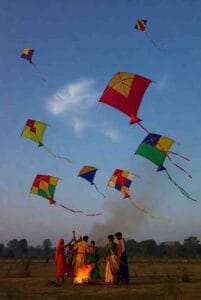
For Gujaratis in India and abroad, Uttarayan is almost inseparable from kite flying.
Kite culture in Gujarat
On and around 14 January:
- People throng rooftops and open spaces from sunrise to sunset.
- They fly kites of many colours and shapes, often trying to cut each other’s strings in friendly competition.
- Food like undhiyu (slow‑cooked winter vegetables) and jalebi (syrupy fried spirals) are prepared in large quantities.
The kite flying has many layers of meaning:
- Enjoying wind and sunlight after colder, shorter days.
- A sense of freedom and aspiration—kites pulling upwards against gravity.
- Still being tethered (by the string) to earth and responsibility.
Safety and adaptation abroad
In India, there has been increasing concern about:
- Injuries and deaths from glass‑coated string (manja)
- Harm to birds and damage to power lines
In the UAE, such string is inappropriate and likely to breach public safety rules. Where kites are flown:
- They must use safe, non‑metallic, non‑glass string.
- They must be flown only in approved open spaces, far from power lines, roads and airports.
- Events require permission; ad‑hoc mass kite flying from crowded rooftops is not acceptable.
In practice, Gujarati communities in the Gulf often:
- Celebrate Uttarayan more through food, music and small indoor kites
- Hold limited, controlled kite sessions in specific parks or fields, if permitted
Why Makar Sankranti 2026 Matters to Indians in the UAE
Keeping roots alive in a transient environment
Expats in the Gulf often describe life as:
- Fast‑paced, busy, focused on work and remittances
- Emotionally rich but also transient—people come and go, visas end, families move on
Festivals like Makar Sankranti, Pongal and Uttarayan serve as anchor points:
- They recur every year, providing continuity in a place where jobs and neighbours may change quickly.
- They help parents pass on stories and values to children who may never have lived in India.
- They keep alive the feeling that “we are part of something bigger than this tall building or this project”.
Making sense of seasons in a desert
The UAE doesn’t have the four classic temperate seasons, but it does have:
- Extreme summer heat (where outdoor life is limited)
- A cooler, pleasant period from roughly November to February
For many Indians, especially those in outdoor or physical jobs:
- The cooler months are when life feels easier—less heat stress, more fresh air.
- Makar Sankranti sits in the heart of this pleasant period.
Even if it’s not about harvest in the literal sense, it becomes a way to say:
- “We’ve survived another year of heat and work.”
- “We are grateful for this more comfortable time, for food, for shelter, for safety.”
Identity and pride in a global crossroads
The UAE is a unique crossroads where:
- Emirati, Arab, Indian, Pakistani, Filipino, African, European and many other cultures meet.
- Indian festivals coexist with Ramadan, Christmas, Chinese New Year and others in public spaces.
For Indians, celebrating Makar Sankranti 2026: Pongal & Uttarayan History, Significance & Why Indians Celebrate UAE is:
- A way to say “this is who we are”, without losing sight of respect for the host country.
- A reminder that one can be a good resident of the UAE and still hold on to Indian rituals.
- A chance to educate others about India beyond stereotypes.
How Makar Sankranti/Pongal/Uttarayan Look in the UAE
Because of laws, climate and housing, Sankranti in the UAE is very different on the surface from India—but the inner meaning can be preserved.
Temples and worship spaces
Hindu temples and Hindu prayer halls (both older ones and newer complexes like the BAPS Abu Dhabi Mandir and Dubai Hindu Temple in Jebel Ali) typically:
- Perform special Sankranti or Pongal pujas in mid‑January.
- Decorate shrines with sugarcane, fruits and flowers.
- Distribute prasad (pongal, sweets) to devotees.
Information is usually available on:
- The temple’s own website and Facebook/Instagram pages.
- Posters at the temple entrance.
Cultural associations and regional groups
Tamil Sangams, Telugu associations, Gujarati Samajs, Marathi groups and others often:
- Rent school halls, hotel ballrooms or community spaces for:
- Pongal cultural nights
- Harvest‑themed shows combining multiple states
- Include dance, music, children’s performances, food stalls and charity fundraising.
Labour camps and staff accommodations
In worker housing and staff accommodation (subject to company and legal permission), you may find:
- Small gatherings in mess halls or common rooms.
- People cooking pongal or sharing sweets like tilgul.
- Informal singing or bhajan sessions.
These are particularly important for workers who may not easily get time off to visit temples or attend external events.
Corporate and school recognition
Some** international schools** and multinational companies with large Indian staff may:
- Acknowledge Pongal/Lohri/Sankranti in newsletters or internal communications.
- Allow staff networks to organise small tasting tables or lunchtime talks.
However, this varies widely by institution and is usually low‑key, focused on cultural awareness rather than ritual.
How Curious Expatriates and Non‑Indian Residents Can Engage
If you’re not Indian but live, study or work with many Indians in Dubai, Abu Dhabi or Sharjah, these festivals are a chance to broaden your understanding of your neighbours.
Simple ways to learn and participate
- Ask Indian friends or colleagues:
- “What does Makar Sankranti/Pongal/Lohri mean to you?”
- Accept invitations to:
- Home gatherings
- Temple open days
- Cultural programmes (clearly marked as open to all)
When visiting temples or community events:
- Dress modestly; be prepared to remove shoes in certain areas.
- Observe respectfully during prayers or rituals—even if you don’t participate.
- Try the food offered; food is a major way Indians share culture and affection.
Good questions to ask
- “How is celebrating this festival in the UAE different from India?”
- “What parts of the festival are most important to your family?”
- “Are there particular foods or stories linked to this day?”
Avoid:
- Making jokes about religious beliefs or customs.
- Forcing people into theological or political debates during what is, for them, a sacred and emotional day.
10‑Step Personal Plan for Makar Sankranti 2026 in the UAE
Whether you’re Indian, non‑Indian, a student, a professional or a long‑term expat, here’s a simple way to engage with Makar Sankranti 2026: Pongal & Uttarayan History, Significance & Why Indians Celebrate UAE.
- Learn the basics (10–15 minutes)
- Read a short overview from a reliable source, such as India’s official portal: https://www.india.gov.in (search “Makar Sankranti”).
- Mark mid‑January 2026 in your calendar
- Add a note like “Makar Sankranti/Pongal – consider temple visit or gathering”.
- Find your nearest Indian worship or community space
- Use Google Maps to locate Hindu temples or Indian cultural associations in your emirate.
- Check their festival announcements
- Look for Sankranti, Pongal or harvest‑festival events on their websites or social media from late December 2025.
- Decide your level of participation
- Will you:
- Visit a temple?
- Attend a cultural show?
- Only celebrate at home?
- Will you:
- Plan one home‑based ritual
- For example:
- Lighting a lamp
- Sharing sweets or pongal
- Spending 10 minutes reflecting on what you’re grateful for.
- For example:
- Talk to someone about it
- If you’re Indian: explain the festival calmly to at least one non‑Indian friend or colleague.
- If you’re non‑Indian: ask an Indian friend about their experience.
- Respect UAE laws and culture
- Avoid unapproved public gatherings, loud late‑night celebrations or risky kite flying.
- Keep celebrations family‑centred and within legal/management permissions.
- Give something, however small
- In India, charity (daan) is part of Sankranti. In the UAE, you might:
- Donate to an approved charity
- Help a colleague, neighbour or someone in your building.
- In India, charity (daan) is part of Sankranti. In the UAE, you might:
- Reflect and plan for 2027
- After the festival, note:
- What did you learn?
- What felt meaningful or difficult?
- What would you like to do differently next year?
- After the festival, note:
Related Guides :
- Makar Sankranti 2026 Celebrations Near Me UK: Kite Flying & Temple Events
- Makar Sankranti 2026 UAE: How to Celebrate in Dubai, Abu Dhabi & Sharjah
- Makar Sankranti 2026 UK: How to Celebrate in London, Leicester & Manchester
- Makar Sankranti 2026: Pongal & Uttarayan History, Significance & Why Indians Celebrate UK
- Makar Sankranti 2026 Celebrations Near Me USA: Kite Flying & Temple Events
Frequently Asked Questions
Is Makar Sankranti or Pongal a public holiday in the UAE?
No.
Makar Sankranti, Pongal, Lohri and related festivals are not public holidays in the UAE.
The UAE’s official public holidays focus on:
- Islamic festivals (Eid al‑Fitr, Eid al‑Adha, etc.)
- UAE National Day and other national occasions
You can see the official list here:
Most people work or attend school as usual on those days and celebrate outside working hours.
Are these festivals only for Hindus?
Makar Sankranti, Pongal and Uttarayan have Hindu ritual roots, but:
- Many culturally Hindu but not very religious people still celebrate them as harvest and Sun festivals.
- In some families, especially in Punjab (Lohri) and Assam (Bihu), Sikhs and others also join in.
- In the UAE, people of different faiths sometimes visit each other’s homes for food and conversation during these times.
So while theology is Hindu‑centred, social participation can be broader.
Can I fly kites for Uttarayan in the UAE like in Gujarat?
Only if it is safe and legally allowed.
You must:
- Avoid flying kites near roads, power lines, buildings or airports.
- Not use glass‑coated or metallic string (dangerous and unacceptable).
- Follow all local municipality rules and building/compound regulations.
In many cases, it’s safer to:
- Attend an officially organised, permitted kite event, or
- Focus on symbolic kites (crafts, decorations) instead.
Are bonfires allowed for Lohri in the UAE?
Open bonfires are usually not allowed in residential areas or public spaces without explicit permission, due to fire risk and regulations.
Lohri in the UAE is often celebrated by:
- Using small, contained flames in controlled venues if permitted, or
- Symbolic representations (electric lights, images) combined with songs and food.
Any event with a real fire should be organised by experienced groups in line with local safety codes.
How can a non‑Indian expat join a Pongal or Sankranti celebration without offending anyone?
You can:
- Ask politely if you may attend a temple open day or cultural event.
- Dress modestly and follow local and venue‑specific etiquette.
- Be open to trying vegetarian dishes and sweets.
- Listen more than you speak when people talk about beliefs and traditions.
Avoid:
- Interrupting rituals or making light of religious language.
- Demanding debates about politics or theology at the event itself.
Most communities are delighted when others show genuine interest and respect.
Conclusion: A Festival of Light, Food and Belonging in the Gulf
At first glance, Makar Sankranti 2026: Pongal & Uttarayan History, Significance & Why Indians Celebrate UAE might look like a niche topic—just one more item in an expat calendar filled with many cultures’ festivals.
But beneath the surface, it’s about deeply human questions:
- How do we mark the return of light and warmth after darker times?
- How do we say thank you for food and work in an age of supermarkets and global supply chains?
- How do we stay connected to our roots, while fully living in a new land?
For Indians in the UAE, Makar Sankranti, Pongal and Uttarayan are living answers. They are ways to honour the Sun and harvest, yes—but also to:
- Gather in temples, flats, camps and halls after long shifts
- Tell children stories of kites, fields and rivers many kilometres away
- Build bridges of understanding with neighbours from dozens of other countries
You don’t have to do everything: no one is counting how many rituals you perform or how many kites you fly. If you:
- Set aside a little time
- Share a little food
- Open your heart to a bit more light
…then you’re already living the spirit of Makar Sankranti 2026 in the UAE.
Whether you’re Indian, Emirati or from any other background, perhaps this mid‑January turning point can be your reminder to ask:
“What am I grateful for? What do I want to let go of? And how can I share a bit more light with the people I live and work alongside?”