Achyutam Keshavam Krishna Damodaram bhajan guide: meanings of Krishna’s names, significance, when to sing, pronunciation tips, and spiritual benefits explained.
Achyutam Keshavam Krishna Damodaram Lyrics: Complete Krishna Bhajan Guide
Achyutam Keshavam Krishna Damodaram is one of the most beloved Krishna bhajans, chanted and sung by devotees worldwide. This powerful devotional song strings together sacred names of Lord Krishna, creating a melodic prayer that has become a staple in temples, yoga studios, and homes across the globe. This guide explores the meaning behind each divine name, when and how to sing this bhajan, and its spiritual significance in Hindu devotional practice.
Within the first 100 words: the Achyutam Keshavam bhajan is a name-based prayer (nama sankirtana) that invokes Krishna through his various divine epithets. Each name reveals a different aspect of Krishna’s nature—from his role as cosmic sustainer to his intimate pastimes in Vrindavan. Below you’ll find explanations of each name’s meaning, guidance on pronunciation, appropriate occasions for singing, and the spiritual benefits devotees experience through regular chanting.
Table of Contents
- Understanding This Krishna Bhajan
- Structure and Format of the Chant
- Meaning of Each Divine Name
- Significance and Spiritual Benefits
- When to Sing This Bhajan
- How to Learn and Practice
- Audio and Video Resources
- Frequently Asked Questions
Understanding This Krishna Bhajan
Achyutam Keshavam is classified as a nama sankirtana—a devotional practice built around chanting or singing the names of God. In Hindu tradition, the divine names themselves carry spiritual power. Speaking, singing, or hearing these names is considered a form of meditation and worship.
This particular bhajan has become extraordinarily popular in recent years, partly due to beautiful renditions available online and its use in yoga and meditation contexts. The melody is simple and repetitive, making it accessible for group singing (kirtan) or personal devotional practice.
Important Note About Lyrics:
Rather than reproduce potentially copyrighted lyrical arrangements, I’m providing the traditional Sanskrit names used in this bhajan along with their meanings. The specific arrangement, musical setting, and extended verses may be under copyright by various artists and composers. For exact lyrics, I recommend:
- Consulting printed bhajan books from temple bookshops
- Listening to authorized recordings on official channels
- Visiting temple websites that offer devotional materials
- Checking legitimate lyric sites that have proper licensing
Structure and Format of the Chant
The bhajan is built as a chain of Krishna’s names, each flowing into the next. The structure creates a meditative, mantra-like quality that helps focus the mind.
The basic pattern repeats divine names in a rhythmic sequence, typically following this general structure:
Opening invocation with primary names
Middle section with additional epithets
Closing returning to opening names or ending with “Namah” (salutations)
The repetition serves both musical and spiritual purposes—the recurring names create a trance-like state conducive to devotion and meditation.
Meaning of Each Divine Name
Understanding what each name means deepens the devotional experience. Here are the primary Krishna names featured in this bhajan:
Achyutam
Meaning: “The Infallible One” or “One Who Never Falls”
This name comes from “a” (not) + “chyuta” (fallen/degraded). Krishna as Achyuta never falls from his supreme position, never fails in his promises, and never abandons his devotees. It emphasizes his eternal, unchanging nature.
Theological significance: While everything in the material world is subject to change and decay, Krishna remains constant and reliable. Devotees chant this name seeking that same stability and constancy in their spiritual lives.
Keshavam
Meaning: “One with Beautiful Hair” or “Slayer of the Demon Keshi”
This name has dual meanings:
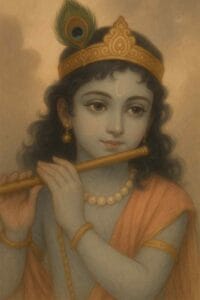
First, “Kesha” means hair—Krishna is famous for his beautiful dark locks adorned with peacock feathers. This represents his captivating beauty.
Second, Krishna killed the horse demon Keshi sent by his uncle Kamsa. Thus he’s called Keshava—destroyer of Keshi.
Theological significance: The beautiful aspect reminds us that God attracts us through love and beauty. The demon-slaying aspect reminds us that Krishna protects devotees from evil.
Krishna
Meaning: “The All-Attractive One” or “The Dark/Blue One”
From the root “krish” (to attract) or referring to his dark blue complexion like a rain cloud. This is Krishna’s primary name.
Theological significance: Krishna attracts all beings through his infinite qualities—beauty, strength, knowledge, renunciation, wealth, and fame. He is the supreme attractor, the magnetic center of existence.
Damodaram
Meaning: “One Bound Around the Belly with Rope”
“Dama” means rope, “udara” means belly. This refers to a famous childhood pastime when Mother Yashoda tied the mischievous butter-stealing Krishna to a grinding mortar with rope.
Theological significance: The Supreme Being allowed himself to be bound by his mother’s love. This shows that while Krishna is unlimited and all-powerful, he submits to pure devotion. It represents the intimate, loving relationship possible between devotee and God.
Rama (often included)
Meaning: “The Pleasing One” or “Source of All Pleasure”
Can refer to Lord Rama (Vishnu avatar) or to Krishna as “Ram” (one who gives pleasure/bliss to devotees).
Vasudevam (often included)
Meaning: “Son of Vasudeva” or “One Who Dwells in All Beings”
Krishna’s earthly father was Vasudeva, making this his patronymic name. Spiritually, it means God dwelling in all hearts.
Madhavam (often included)
Meaning: “Husband of the Goddess of Fortune” or “Sweet Like Honey”
Refers to Krishna/Vishnu as the consort of Lakshmi. Also means “of the Madhu dynasty” or “sweet as honey/spring.”
Madhusudanam (often included)
Meaning: “Slayer of the Demon Madhu”
Vishnu/Krishna destroyed the demon Madhu, who represents ignorance and spiritual lethargy.
Govinda (often included)
Meaning: “One Who Gives Pleasure to the Cows and Senses”
“Go” means cow (or senses), “vinda” means one who gives pleasure. Krishna is the cowherd who delights the cows and by extension, all of nature and all beings.
Janardhana (often included)
Meaning: “One Worshiped by All People” or “Protector from Evil People”
From “jana” (people) and “ardhana” (worship) or “ardhana” (tormentor/destroyer). Krishna is both universally worshiped and the destroyer of those who torment devotees.
Each Name Is a Meditation:
When you sing or chant these names, you’re not just making sounds. You’re meditating on specific divine qualities. “Achyutam” reminds you of God’s reliability. “Damodaram” reminds you of love’s power to bind even the infinite.
Significance and Spiritual Benefits
Why This Bhajan Matters:
Nama Smarana (Remembrance Through Names): Hindu tradition holds that remembering and chanting God’s names purifies consciousness. The names themselves carry divine vibration.
Accessible Practice: Unlike complex rituals requiring materials and training, singing names only requires your voice and devotion. Anyone can practice anywhere.
Multi-Dimensional Devotion: Each name touches a different aspect of Krishna—his cosmic form, his childhood pastimes, his protective power, his beauty. Singing them all creates a complete meditation.
Community Building: This bhajan has become a common kirtan (group devotional singing) piece, creating shared experience across different Hindu traditions and even in Western yoga communities.
Spiritual Benefits Devotees Report:
- Mental peace and reduced anxiety
- Feeling of divine presence and protection
- Improved focus and concentration
- Emotional healing and comfort during difficulties
- Sense of connection to the global Krishna bhakti community
- Joy and uplifting of spirits
Theological Framework:
In Krishna theology (particularly as taught by Chaitanya Mahaprabhu and the Gaudiya Vaishnava tradition), the name and the named are non-different. That is, Krishna’s name IS Krishna. Therefore, chanting the name is direct communion with the divine.
The Bhagavad Gita teaches that in Kali Yuga (the current age), nama sankirtana (congregational chanting of God’s names) is the recommended spiritual practice for most people—more accessible than complex yogic practices or elaborate rituals.
When to Sing This Bhajan
Daily Personal Practice:
Morning devotions after bathing and before breakfast
Evening prayers at dusk
During personal meditation or japa
While doing household work as background devotion
Before sleep to quiet the mind
Temple and Group Settings:
Weekly satsangs and bhajan sessions
Before and after spiritual discourses
During kirtan gatherings
As part of temple aarti ceremonies
Festival Occasions:
Janmashtami (Krishna’s Birthday): This is THE occasion for Krishna bhajans. Temples and homes sing continuously through the night leading to midnight, Krishna’s birth time. Achyutam Keshavam fits perfectly into Janmashtami programs.
Radhashtami (Radha’s Appearance Day): Celebrated 15 days after Janmashtami, this festival also features Krishna-Radha bhajans.
Govardhan Puja: The day after Diwali, celebrating Krishna lifting Govardhan mountain.
Ekadashi: The 11th lunar day observed twice monthly by many Krishna devotees, often with fasting and increased chanting.
Kartik Month: October-November in the lunar calendar is especially sacred to Krishna worship. Daily singing of Krishna names is emphasized.
Other Appropriate Times:
Before beginning any new venture: Invoking Krishna’s names removes obstacles
During difficulty or fear: The names provide protection and courage
While traveling: Keeps consciousness connected to the divine
In hospitals or during illness: Provides comfort and spiritual strength
At the end of other devotional practices: As a closing prayer
Yoga and Meditation Contexts:
This bhajan has crossed over into Western yoga studios and meditation centers. It’s frequently used as:
- Opening or closing chant for yoga classes
- Background for meditation sessions
- Kirtan (call-and-response chanting) in yoga communities
- Mantra for japa (repetitive chanting) practice
The simple, repetitive structure makes it ideal for extended chanting sessions where the melody and names create a meditative state.
How to Learn and Practice
For Beginners:
Step 1: Listen Repeatedly
Before trying to sing, listen to a version you like at least 10-15 times. Let the melody and rhythm sink into your memory naturally.
Step 2: Learn Name by Name
Don’t try to learn everything at once. Focus on pronouncing each divine name correctly:
- Achyutam: Ah-CHYU-tam
- Keshavam: Kay-SHA-vam
- Krishna: KRISH-na
- Damodaram: Daa-mo-DAR-am
Step 3: Chant Along
Once you’re familiar with the melody, chant along with recordings. Don’t worry about perfect pronunciation initially—sincerity matters more than perfection.
Step 4: Independent Practice
Try singing without the recording. Start slowly. Speed and fluency come with practice.
For Advancing Practice:
Understanding Meaning: As you chant each name, hold its meaning in your mind. “Achyutam”—remember that Krishna never fails. “Damodaram”—visualize baby Krishna bound by mother’s love.
Feeling Devotion: Move beyond mechanical repetition to feeling. Let emotion enter your voice—longing, love, gratitude, surrender.
Extended Chanting: Work up to chanting for 10, 20, or 30 minutes continuously. The extended practice creates deeper meditative states.
Group Kirtan: Join or organize kirtan groups where call-and-response singing creates collective devotional energy.
Daily Commitment: Even 5 minutes daily is more valuable than an hour once a week. Consistency builds the devotional habit.
Integration with Other Practices:
This bhajan works beautifully alongside:
- Japa meditation (chanting while counting on beads)
- Reading Krishna scriptures (Bhagavatam, Bhagavad Gita)
- Deity worship (singing before Krishna murti)
- Yoga practice (as opening/closing invocation)
- Breath awareness (chanting with conscious breathing)
Audio and Video Resources
Finding Quality Recordings:
YouTube: Search “Achyutam Keshavam Krishna Damodaram” to find numerous versions. Look for:
- Temple recordings for traditional renditions
- Popular devotional artists for melodious versions
- Kirtan groups for participatory call-and-response style
- Lyric videos (though verify they’re properly licensed)
Music Streaming Platforms:
Spotify, Apple Music, and other services have devotional sections with various renditions. Popular artists who have recorded Krishna bhajans include Anuradha Paudwal, Jagjit Singh, and various ISKCON artists.
ISKCON Resources:
ISKCON (International Society for Krishna Consciousness) centers often have recordings and teaching materials for Krishna bhajans. Check www.iskcon.org for resources.
Temple Websites:
Many temples offer audio downloads of bhajans and kirtans from their regular programs.
Apps:
Hindu devotional apps like Krishna Bhajan, Hindu Calendar, and various kirtan apps include collections of Krishna chants.
Learning Pronunciation:
YouTube videos with on-screen transliteration help with pronunciation. Search for versions specifically labeled “with lyrics” or “sing along.”
Copyright Consideration:
When using recordings, ensure they’re from legitimate sources. Support artists and organizations by using official channels rather than unauthorized copies.
Meaning and Significance
The Power of Divine Names:
In Vaishnava (Vishnu/Krishna-focused) theology, God’s name is considered non-different from God himself. This means that chanting “Krishna” is direct communion with Krishna—not merely talking about him, but encountering his presence through sound.
The Bhagavad Gita states that among Krishna’s vibhutis (glories) is that he is “Om among words”—sound itself is a manifestation of the divine. Names, especially revealed names from scripture, carry that same divine presence.
Why Multiple Names:
Krishna has 108 primary names and countless epithets. Each reveals a different facet of his infinite personality:
- Some names describe his cosmic role (preserver of the universe)
- Some describe his physical beauty (dark-complexioned, beautifully-haired)
- Some describe his pastimes (butter thief, cow-protector, Govardhan lifter)
- Some describe his relationships (son of Vasudeva, beloved of Radha)
- Some describe his powers (demon-slayer, wish-fulfiller)
By chanting multiple names in sequence, devotees meditate on Krishna’s complete nature rather than a limited aspect.
Achyutam Keshavam as Complete Prayer:
This particular combination of names creates a balanced spiritual practice:
- Achyutam establishes Krishna’s transcendent, unchanging nature
- Keshavam brings in both beauty and protective power
- Krishna is the central, personal name—the all-attractive one
- Damodaram grounds us in the intimate, loving relationship (mother binding child)
Together, they move from the cosmic to the personal, from power to love, from the infinite to the accessible.
Experiential Dimension:
Devotees often report that extended chanting of these names creates:
- A sense of Krishna’s presence
- Emotional release and catharsis
- Mental quieting and peace
- Spontaneous devotional feelings (bhava)
- Joy and uplifting without external cause
These experiences are understood not as psychological effects but as actual spiritual contact—Krishna responding to being called by name.
Theological Context:
This bhajan fits within the broader tradition of Bhakti Yoga (devotional path). According to Bhakti texts:
The easiest and most effective spiritual practice for most people is hearing and chanting God’s names (shravana and kirtana). Complex philosophical understanding, difficult yogic practices, and elaborate rituals are not necessary. Simple, sincere chanting of divine names can lead to full spiritual realization.
The Chaitanya Charitamrita, a key text of Gaudiya Vaishnavism, emphasizes that the holy names are the primary spiritual practice for the current age. This bhajan embodies that teaching.
When to Sing This Bhajan
Daily Personal Practice
Morning Devotions:
After bathing and before breakfast, sit before your home altar or in a quiet space. Sing or chant this bhajan 3, 7, or 11 times. This sets a devotional tone for the day ahead.
Evening Prayers:
At dusk (sandhya time), when day transitions to night, is considered powerful for spiritual practice. Chanting Krishna’s names at this time is traditional and effective.
Before Meditation:
Use this bhajan as preparation for silent meditation. The names focus and purify the mind, making deeper meditation more accessible.
During Daily Activities:
Many devotees play recordings while cooking, cleaning, or doing repetitive work. This transforms mundane activity into devotional service.
Festival and Special Occasions
Janmashtami (Krishna’s Birthday):
This is the primary occasion for Krishna bhajans. The festival falls in August or September on the eighth day of the dark fortnight in the month of Bhadrapada.
Traditional Janmashtami observance includes:
- All-night singing and chanting leading to midnight (Krishna’s birth time)
- This bhajan fits perfectly in the rotation of songs throughout the night
- Many temples organize continuous kirtan for 24 or 48 hours
- Home celebrations include singing Krishna bhajans from evening through midnight
Ekadashi (11th Lunar Day):
Observed twice monthly by Krishna devotees, Ekadashi is a fasting and spiritual practice day. Many devotees spend extra time chanting and singing on Ekadashi. This bhajan works well for extended chanting sessions.
Kartik Month (Oct-Nov):
The lunar month of Kartik is considered especially sacred to Krishna. Daily singing of Krishna names and bhajans is prescribed. Many devotees commit to singing this bhajan daily throughout Kartik.
Govardhan Puja:
The day after Diwali celebrates Krishna lifting Govardhan mountain. Krishna bhajans including this one are sung throughout the day.
Radhashtami:
Fifteen days after Janmashtami, Radha’s appearance day is celebrated with singing focused on Radha and Krishna’s divine love.
Temple and Community Settings
Weekly Satsangs:
Many temples hold weekly bhajan or kirtan evenings. This bhajan is often included in the rotation.
Before Discourses:
Spiritual talks and scripture classes often begin with devotional singing to create the right atmosphere.
During Aarti:
While not typically used as the main aarti, this bhajan can be sung before or after formal aarti ceremonies.
Community Kirtans:
Kirtan groups (both temple-based and independent) frequently include this bhajan. The call-and-response format works well for group singing.
Life Circumstances
During Difficulty:
Krishna is known as the protector of devotees. Chanting his names during troubled times is traditional—whether facing illness, financial stress, relationship problems, or fear.
Before Important Events:
Students before exams, professionals before interviews, anyone beginning a new venture can invoke Krishna’s blessings through nama sankirtana.
In Times of Grief:
The names provide comfort and the reminder that Krishna is present even in suffering.
For Spiritual Dryness:
When devotional feeling has faded or spiritual practice feels mechanical, returning to simple name chanting can reignite devotion.
Daily Householder Life:
For those living busy family and work lives (not renunciates or monks), this bhajan offers accessible daily practice that doesn’t require extensive time or materials—just a few minutes and your voice.
Read this also :
- Jai Ganesh Deva Aarti Lyrics Hindi English: Complete Ganpati Guide
- Hindu Temples Near Me USA: Complete Directory State Wise Mandirs
- Jai Ambe Gauri Aarti Lyrics Hindi English: Complete Durga Mata Guide
- Jai Lakshmi Mata Aarti Lyrics Hindi English: Complete Diwali Guide
- Om Jai Shiv Omkara Aarti Lyrics Hindi English: Complete Shiva Aarti
Frequently Asked Questions
Do I need to understand Sanskrit to sing this bhajan?
No. While understanding enriches the experience, the tradition holds that the names carry power even when you don’t fully comprehend their meanings. Millions of devotees chant Sanskrit mantras without fluent understanding. That said, knowing what you’re saying definitely deepens devotion, which is why this guide explains each name.
Can non-Hindus sing Krishna bhajans?
Yes. Bhakti (devotion) is about the heart’s sincerity, not ethnic or religious background. ISKCON temples, which are Krishna-focused, have welcomed thousands of Western devotees since the 1960s. If you feel drawn to Krishna, that itself is considered Krishna’s grace inviting you.
How many times should I chant it?
There’s no fixed requirement. Traditional auspicious numbers are 3, 7, 11, 27, or 108 repetitions. For extended practice, devotees may chant for a set time (15 minutes, 30 minutes, an hour) rather than counting. Do what feels natural and sustainable.
Should I sing it or just listen?
Both have value. Listening with attention is a valid devotional practice (shravana). Singing engages your body and voice more fully, which some find creates stronger connection. Many people start by listening and naturally transition to singing along.
What if I can’t carry a tune?
God doesn’t judge your singing voice. Krishna famously accepted whatever was offered with love—whether a leaf, water, or simple devotion. Your musical skill is irrelevant. Sincerity is everything.
Can I chant this while doing other activities?
Yes. Many devotees chant or play Krishna bhajans while cooking, cleaning, driving, or walking. The tradition recognizes that householders can’t spend all day in formal meditation, so integrating practice into daily life is encouraged.
Is there a best time of day?
Dawn (Brahma muhurta, roughly 4-6 AM) is considered especially powerful for spiritual practice. Dusk (sandhya time) is also excellent. But honestly, whenever you actually will do it is the best time. Consistency matters more than perfect timing.
Do I need to be vegetarian to chant Krishna’s names?
This is a topic of some debate. Traditional Krishna devotion, especially in ISKCON and other Vaishnava communities, includes vegetarianism as an expression of ahimsa (non-violence) and respect for Krishna’s teachings. However, many people chant Krishna’s names without being vegetarian. It’s a personal spiritual journey—some find dietary changes follow naturally as devotion deepens.
Can women sing this during menstruation?
Progressive and most modern Hindu communities say yes—Krishna is beyond such physical considerations. Some orthodox traditions maintain restrictions. This is ultimately a personal decision based on your comfort level and family tradition.
Is this a mantra or a bhajan?
It’s a bhajan (devotional song) built from mantric names. The distinction: a mantra has specific syllabic structure and is often given by a guru for personal practice. A bhajan is a devotional song accessible to all, often sung in groups.
How is this different from the Hare Krishna Mahamantra?
The Hare Krishna Mahamantra (Hare Krishna Hare Krishna, Krishna Krishna Hare Hare / Hare Rama Hare Rama, Rama Rama Hare Hare) is considered the primary mantra of the age by Gaudiya Vaishnavas. Achyutam Keshavam is a bhajan using different names. Both are valid—the Mahamantra is often used for japa (repetitive personal chanting), while bhajans like Achyutam Keshavam are often sung in groups or for variety in practice.
Where can I find the full accurate lyrics?
For legally published lyrics, check:
Official temple bhajan books
Licensed devotional music platforms
ISKCON-published songbooks
Legitimate Hindu devotional websites with proper sourcing
Avoid unauthorized lyric reproduction sites.
Conclusion
Achyutam Keshavam Krishna Damodaram bridges ancient devotional tradition and contemporary spiritual practice. Whether chanted in a centuries-old temple in Vrindavan or sung in a New York yoga studio, whether repeated by an elderly grandmother doing her morning puja or by a teenager seeking meaning, these sacred names carry the same essential power: they invoke the presence of the all-attractive, infinitely loving divine person.
The beauty of this practice is its simplicity. You don’t need special initiation, expensive materials, scholarly knowledge, or years of training. You need only a voice, a few minutes, and a sincere heart.
Your Next Steps:
Find a recording you connect with emotionally and listen daily for one week. Let the names become familiar friends. Then begin singing along, softly at first, then with more confidence. Make it part of your morning or evening routine.
If you visit a temple, listen for this bhajan during programs. Notice how it’s sung, how people participate, how the energy shifts in the room.
Consider joining a kirtan group, either at a temple or through local yoga communities. Singing with others creates a different, powerful experience than solo practice.
Most importantly, approach the names with respect and openness. You’re not just singing words or making pleasant sounds. You’re calling the Divine by name, and according to tradition, the Divine always answers when called sincerely.
Radhe Radhe. Hare Krishna.
Have you experienced the Achyutam Keshavam bhajan? Does it resonate with you? What’s your favorite recording or memory of singing it? Share in the comments below.